
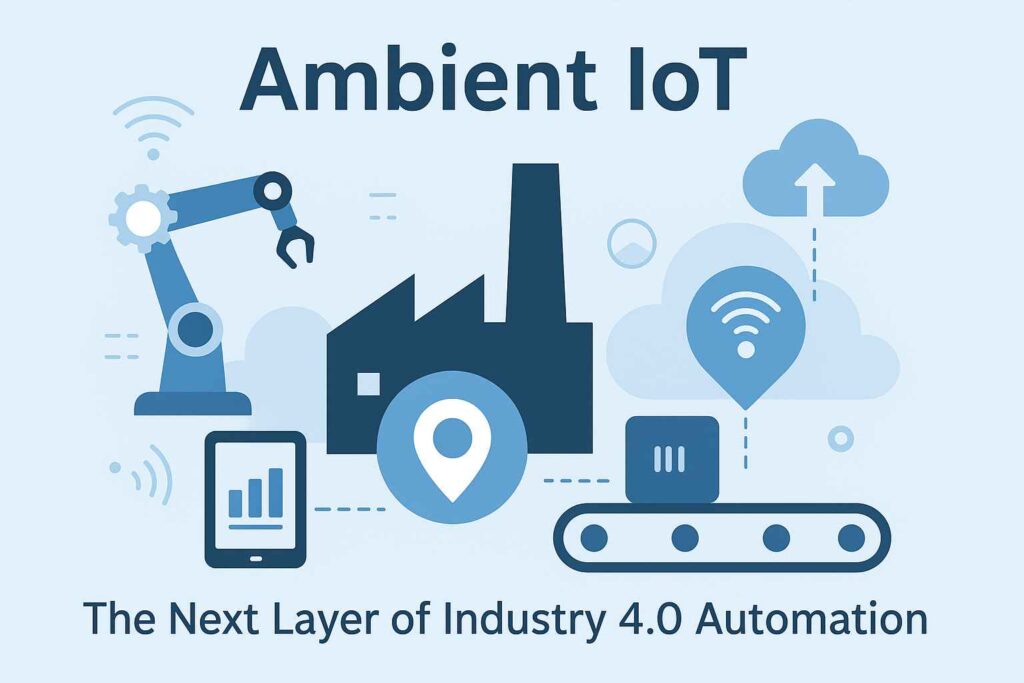

Ambient IoT is transforming factories by making asset tracking automatic, battery-free and continuous. Unlike barcodes, RFID or UWB, Ambient IoT delivers real-time, zone-level visibility without manual scans or maintenance. This article explains how it works, why industry needs it and how it unlocks self-optimizing, fully autonomous industrial operations.
In factories today, robots weld, conveyor belts move on precise schedules, and AI predicts machine failures before they happen. It looks futuristic — and it is.
But there’s one part that’s still surprisingly old-fashioned:
👉 Factories still lose track of physical items.
- Pallets vanish in storage areas
- Tools get misplaced
- Parts reach the wrong workstation
- Shipments get delayed due to mix-ups
These problems don’t happen because technology is missing — almost all factories have barcodes, RFID, or sensors.
The issue is: tracking isn’t automatic. It still needs people or specific scanning points.
This is where Ambient IoT comes in — a new approach that makes asset tracking continuous, wireless, battery-free, and invisible to the user.
Let’s break it down in simple language.
What Is Ambient IoT? (Explained Simply)
Think of Ambient IoT as a layer of intelligence that runs in the background — like Wi-Fi, but for tracking physical objects.
In simple terms:
Every item gets a tiny tag →
The tag sends signals automatically →
The factory always knows where everything is →
No scanning, no batteries, no human involvement.
It’s similar to how your phone automatically stays connected to mobile towers — you don’t “check in” manually.
Ambient IoT makes assets behave the same way.
Why Older Tracking Technologies Fall Short
1. Barcodes
- Super cheap
- But require manual scanning at every step
- If someone forgets to scan → the item becomes “invisible”
2. RFID
- Automatic, but only at fixed gate points
- Expensive to install
- Doesn’t give real-time movement inside the factory
3. UWB (Ultra-Wideband) Tags
- Very accurate location
- But costs ₹4,000–₹6,000 per tag → impossible for thousands of items
- Better suited for tracking expensive assets
4. LoRa / Long-range networks
- Great for large outdoor areas
- Not precise enough indoors — can’t tell which shelf or zone an item is on
The problem with all these options:
They track items some of the time, not all the time.
Factories need something continuous, automatic, and low-cost.
How Ambient IoT Fixes This (The Big Idea)
Ambient IoT uses battery-free Bluetooth Low Energy (BLE) tags that are powered wirelessly.
How do they work?
- The facility installs Wireless Power Network (WPN) bridges
- These bridges send energy through the air (safe, low-power)
- BLE tags “harvest” that energy and stay alive
- Tags continuously send location + sensor data
- The entire factory becomes trackable in real time
Benefits
✔ No batteries → No maintenance
✔ Extremely low cost → Deploy thousands easily
✔ Works everywhere in the facility
✔ Zone-level accuracy (10–15 inches)
✔ Fully automatic → No manual scanning
This finally makes asset visibility ambient, just like air conditioning or Wi-Fi — always on, in the background.
Real Industrial Use Cases (Explained Simply)
🏭 1. Steel Manufacturing
Heavy pallets move across large areas.
Ambient IoT helps track their exact position so nothing gets stuck in the wrong bay.
🧸 2. Toy Production
Small plastic parts often disappear.
BLE tags can track bins and crates without adding cost.
🚚 3. Warehousing / Logistics
Forklifts, tools, packages — all tracked continuously.
Workflow issues become instantly noticeable.
🧰 4. Tool Tracking
Factories lose tools more than they admit — small items get misplaced.
Ambient IoT solves this entirely.
Why This Is the “Last Mile” of Industrial Automation
Industry 4.0 promised self-optimizing factories, but a factory can’t self-optimize if it doesn’t know where everything is.
Today’s problem:
Robots are smart.
AI is smart.
Machines are smart.
But asset tracking is dumb — still manual, still partial.
Ambient IoT changes the game:
- No scans
- No check-ins
- No battery swaps
- No workflow interruptions
- Data flows automatically, all the time
Once you track asset movement continuously, new insights appear:
🔸 Tools consistently left in the wrong area
🔸 Materials that stay idle too long
🔸 Items that move in inefficient patterns
🔸 Bottlenecks that were invisible earlier
This is industrial self-awareness.
The Future: What’s Coming Next in Ambient IoT
Here are upcoming developments your readers will find exciting:
1. Battery-free sensors for temperature, vibration, humidity
Not just location — tags will measure:
- Temperature of perishable goods
- Vibration of heavy machines
- Humidity for warehouses
- Light exposure for pharmaceuticals
2. 3D indoor mapping
Factories will have real-time 3D layouts with moving digital twins of every object.
3. AI-driven workflow optimization
AI will:
- Predict stockouts
- Optimize material flow
- Auto-reorder parts
- Flag abnormal movement of expensive tools
4. Autonomous robots that use Ambient IoT
AGVs and mobile robots will navigate better using live tag data.
5. Integration with supply-chain systems
From suppliers → factory → warehouse → customer
Everything will be tracked through a single ambient layer.
Final Summary (Simple & Powerful)
Industry 4.0 is almost complete.
Robots, AI, predictive maintenance — all exist.
But one fundamental layer was missing:
👉 The ability to see everything, all the time, automatically.
Ambient IoT is that missing layer.
It turns factories into intelligent environments where asset data flows like electricity — silently and continuously.
Factories that adopt this today will become the self-optimizing factories of tomorrow.


